



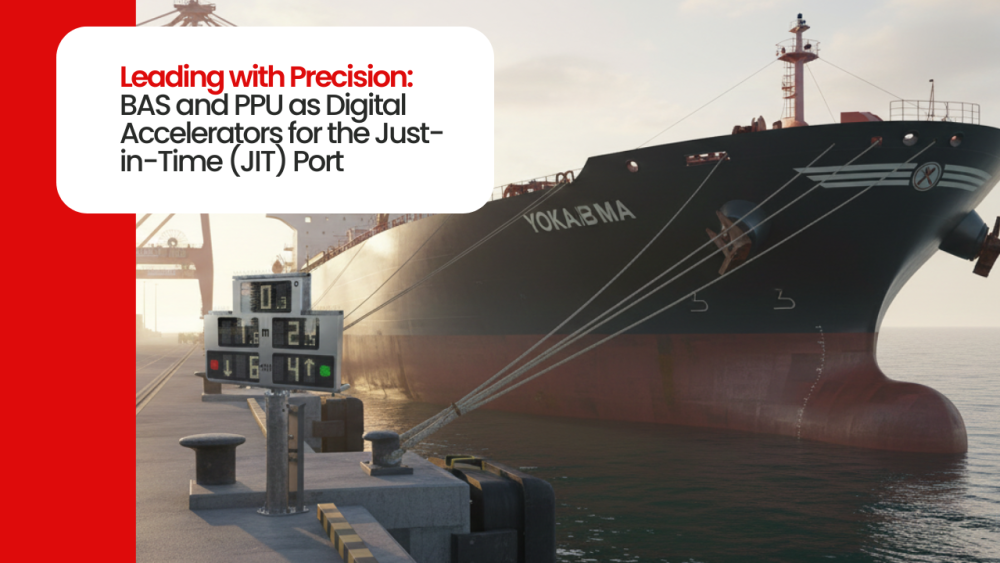
In the new era of Port 4.0, efficiency, sustainability, and digitalization are no longer aspirations but strategic imperatives. Ports, as key nodes of the global economy, face increasing pressure to reduce emissions, boost productivity, and adapt to larger vessels with more demanding operational windows.
In this context, precision becomes the new competitive advantage, and technologies such as the BAS (Berthing Aid System) and the Portable Pilot Unit (PPU) emerge as essential accelerators for achieving a true Just-in-Time (JIT) port model.
Port 4.0: Between Digital Transformation and the Efficiency Crisis
Digitalization and sustainability have consolidated as the major megatrends redefining the maritime-port sector. Ports must evolve towards more agile, connected, and intelligent environments to:
- reduce operational costs,
- optimize vessel calls,
- decrease their carbon footprint,
- and respond to increasingly intense activity peaks
The arrival of technologies such as IoT, Big Data, and Artificial Intelligence enables the development of Smart Ports capable of anticipating fluctuations, automating processes, and making real-time, data-driven decisions.
But a challenge persists: although digital platforms and single windows have been deployed, few ports have succeeded in transferring that digitalization to the critical maneuver, the moment where every second counts—berthing, mooring, and navigation during approach.
Digitalization Is the Maneuver for Just-in-Time
The Just-in-Time (JIT) concept in maritime transport focuses on avoiding unnecessary waiting times and optimizing planning to reduce port stay durations, fuel consumption, and greenhouse gas (GHG) emissions.
Every minute saved during the maneuver allows a vessel to sail at more efficient speeds, with a direct impact on sustainability and operational costs.
But for JIT to be achievable, the maneuver must be precise—and for the maneuver to be precise, digitalization must materialize in real, real-time tools.
That is where BAS and PPU come into play.
BAS (Berthing Aid System): Critical Precision in Berthing
The BAS monitors in real time all the variables involved in berthing:
- vessel speed and angle,
- lateral distances,
- forces during the maneuver,
- environmental conditions,
- and safety parameters.
This enables safer berthings, risk reduction, optimization of the operational window, and high-precision data-driven decision-making.
In a digital port, the BAS becomes the nervous system that transforms the maneuver into quantifiable, actionable information.
PPU (Portable Pilot Unit): Precision Navigation for the Pilot
The Portable Pilot Unit (PPU) provides the pilot with a portable advanced navigation system, delivering dynamic, reliable, real-time data fully integrated into the maneuver.
The PPU not only enhances safety during vessel arrival and departure; it also enables synchronization with the port’s JIT planning, reducing times and increasing the overall efficiency of the logistics chain. bio rose_ts
Together, BAS and PPU turn digitalization into a true operational accelerator.
Long-Term Value: Resilient Ports and Reduced Risk of Stranded Assets
The future of the port sector will depend on its ability to integrate technology with a clear operational purpose. Just-in-Time efficiency is not achieved through digital platforms alone; it becomes a reality when precision systems—such as BAS and PPU—transform every maneuver into a safer, faster, and more efficient operation.
Prosertek drives this transformation by positioning precision and data as the new standard for Port 4.0.
Comments are closed.