



The port sector manages some of the most strategic infrastructures for global trade. Its assets (berths, mooring equipment, fenders, platforms, and critical systems) are designed for very long service lives and require significant investment to adapt to a rapidly changing environment.
Protecting these investments is therefore a key strategic challenge for any port authority committed to competitiveness and long-term resilience.
The strategic challenge: Protecting long-life infrastructure
Ports face two major threats that put the long-term viability and profitability of their assets at risk:
The impact of climate change:
Located on the front line of the coastline, ports are especially vulnerable to:
- rising sea levels,
- increased frequency of storms and extreme waves,
- accelerated corrosion,
- and direct impacts on navigation and infrastructure.
This requires shifting from simple sustainability to port resilience, understood as the ability of physical and digital infrastructure to adapt to changing conditions and remain safe and operation over the long term.
Without adequate adaptation measures, these risks can compromise operational continuity and the competitiveness of maritime transport.
The constant evolution of the fleet
The arrival of larger vessels demands infrastructure capable of withstanding greater loads and new berthing configurations:
- berth extensions,
- upgrades of quick release hooks,
- higher-capacity bollards,
- modernization of locks and cargo-handling equipment.
Infrastructure must evolve at the same pace as the industry to avoid becoming obsolete and turning into a stranded asset, an asset taht loses economic value before the end of its lifecycle.
Engineering and predictive maintenance: the key to ensuring reliability
Protecting investment requires a paradigm shift: moving from reactive maintenance to a predictive, specialized approach capable of anticipating failures, improving reliability, and extending the life span of port assets.
Prosertek offers a set of services specifically designed to ensure the integrity and performance of infrastructure.
- Technical Assistance Service (TAS): Preventive and corrective maintenance carried out by expert personnel equipped with advanced technology. It ensures maximum operational availability and minimizes unexpected downtime.
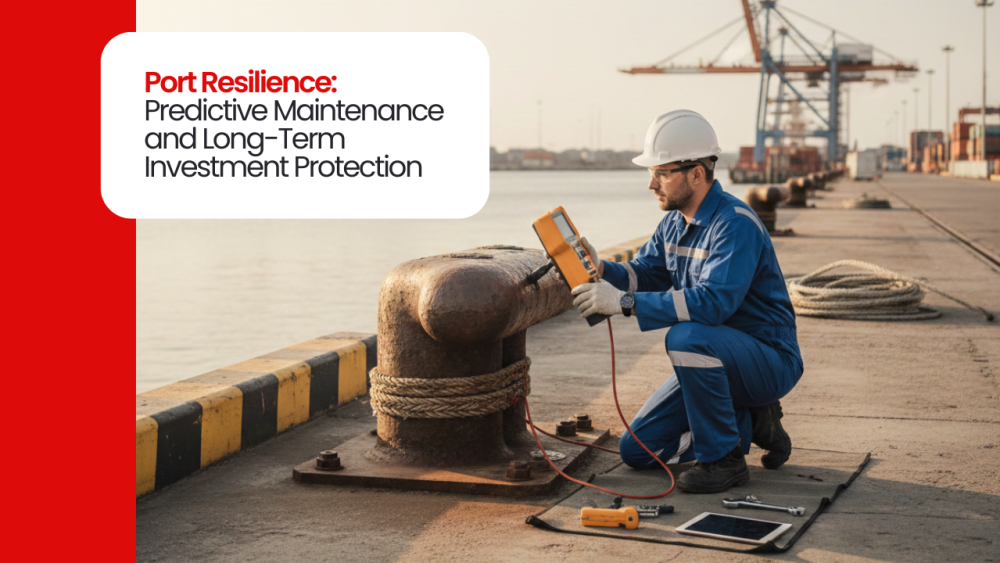
- Non-destructive testing (NDT) of bollards: Bollards are critical components of the mooring system. Their failure can compromise vessel and berth safety. Non-destructive testing allows for an internal assessment of their condition without interrupting operations, ensuring they meet structural and load requirements.
- Underwater maintenance services: Essential for infrastructure continuously exposed to the marine environment. These services help detect corrosion, damage, or wear in piles, structures, and submerged elements.
Resilience as a guarantee for the future
The ultimate goal is to maximize the economic performance of port infrastructure without compromising social or environmental development. To achieve this, ports require:
- specialized engineering
- predictive maintenance
- and a strategic, resilience-focused vision
With our global experience and advanced services, Prosertek helps ports protect their investment, ensure operational continuity, and prepare for future challenges.
Comments are closed.