

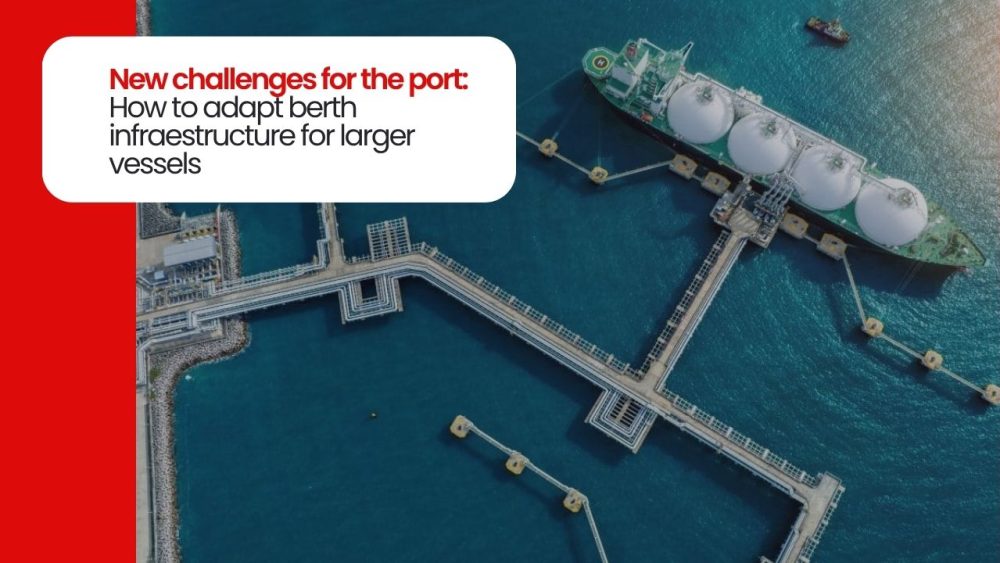
Vessels have been getting bigger for decades. In container shipping, where the trend is most visible, the average size of the global fleet has more than quadrupled since the mid-1980s, according to Clarksons data reported by ANAVE, the Spanish Shipowners’ Association.
For ports, this poses a very specific challenge: many berths were designed for smaller fleets and are now receiving larger vessels. And this is the key point: just because a vessel physically fits alongside the quay does not mean the berth is ready to receive it safely.
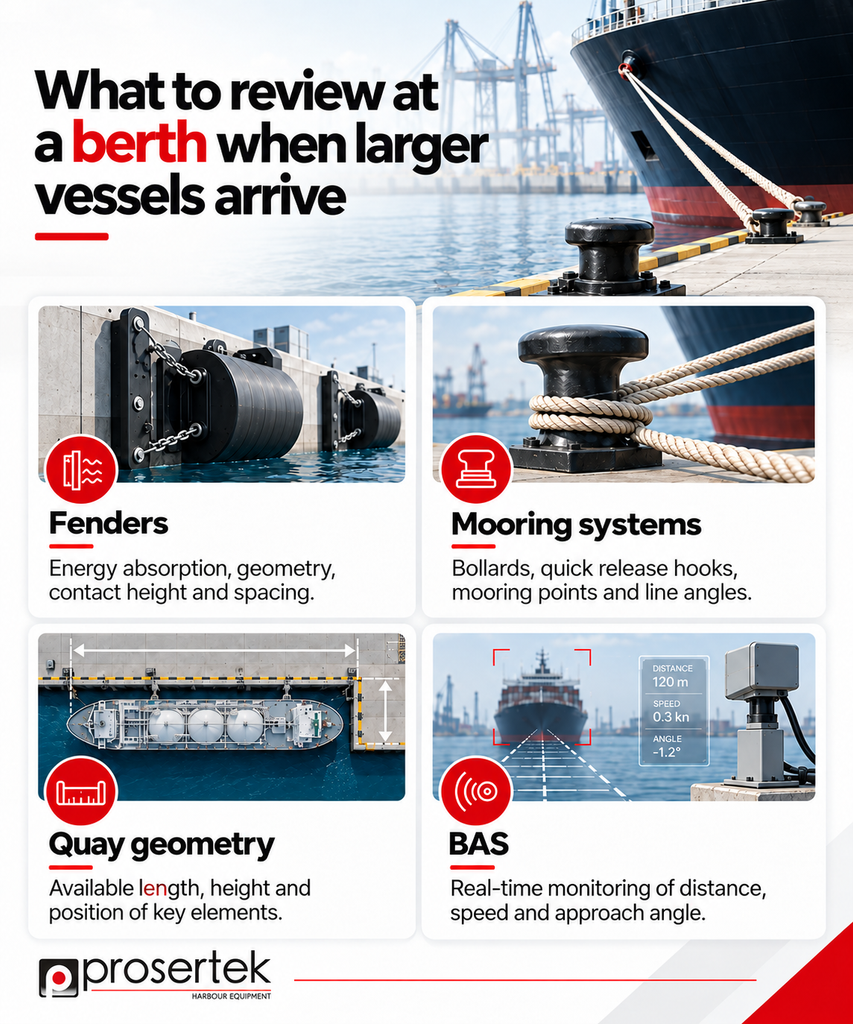
So when a port starts receiving larger vessels, which elements need to be reviewed to know whether the berth is still suitable? This guide covers the main ones: fenders, mooring systems, berth geometry and berthing aid systems.
Why larger vessels change the demands on the berth
A larger vessel is not simply a scaled-up version of the previous one. Its greater displacement increases the energy that must be absorbed on contact with the quay, and that energy also grows with the square of the approach speed, so small variations in the manoeuvre have a noticeable effect.
Other factors come into play: a larger surface area exposed to wind and current, which increases the loads on the mooring lines, and a different length, beam or hull shape, which changes the contact points with the fenders and the angles of the mooring lines. When these parameters change significantly, so do the loads that the whole infrastructure must withstand.
What to review at a berth when larger vessels arrive
Fenders: energy absorption and system geometry
Marine fenders absorb the energy generated when a vessel contacts the quay, which makes them the first element to review. With a larger vessel, it is necessary to check that absorption capacity is still sufficient, but also other aspects: contact height, panel size, spacing between fenders and how the system interacts with the hull form. International guidelines such as those published by PIANC specifically emphasise analysing each installation individually rather than applying a standard solution.
Mooring systems: bollards, quick release hooks and line layout
Once alongside, the vessel must stay safely secured against wind, currents, waves and tides. A larger vessel can change both the loads and the arrangement of the mooring lines, so it is important to review the capacity of bollards and quick release hooks, the location of mooring points, line angles and how loads are distributed while the vessel is alongside.
Berth geometry: length, height and position of mooring points
Sometimes the main constraint is not the equipment but the configuration of the berth itself: available length, quay height, or the position of fenders and mooring points. A larger vessel may be able to use the facility physically and still cause some elements to work in less favourable positions than originally intended: mooring lines at different angles, areas of the hull making unplanned contact with the fenders, or access points to the vessel displaced from the existing facilities.
Berthing Aid System (BAS): real-time control of the manoeuvre
With large vessels, small variations during the manoeuvre can result in significant differences in the energy the fenders must absorb. A Berthing Aid System (BAS) provides real-time data on distance, speed and angle of approach, reducing uncertainty and supporting decision-making. Monitoring mooring loads can also help detect situations that need attention while the vessel is alongside.
Adapting a berth to larger vessels does not mean rebuilding the whole infraestructure
The fact that infrastructure has been in service for years does not mean it is obsolete. A technical assessment can identify which elements remain suitable and which need a specific upgrade: replacing or enlarging fenders, reinforcing or redistributing mooring points, or introducing monitoring and berthing aid systems.
This approach allows the berth to evolve progressively, making use of existing assets and preventing day-to-day operations from being the point at which the berth’s limitations are first discovered. You can explore this idea further in Port Infrastructure Modernisation: A Key Strategy for Efficiency, Safety and Sustainability.
At Prosertek, we design port equipment solutions tailored to the specific requirements of each berth. From fender and mooring systems to berthing aid technologies, our engineering team helps port infrastructure evolve in line with the vessels it needs to accommodate.
Would you like to know whether your berth is ready for the vessels of tomorrow? Contact our technical team.
Comments are closed.